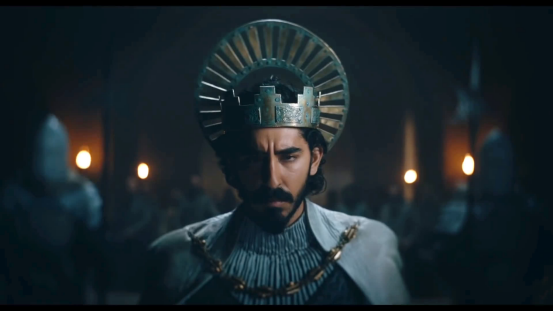
“The Green Knight,” a fantasy film directed by David Lowery, is based on the famous medieval poem “Sir Gawain and the Green Knight.” The film blends elements of fantasy, adventure, philosophy, and poetry, transporting viewers into a world of psychedelic coloring and psychological exploration. More than just a sword-and-sorcery adventure, it offers a profound reflection on themes of life, honor, courage, and death.
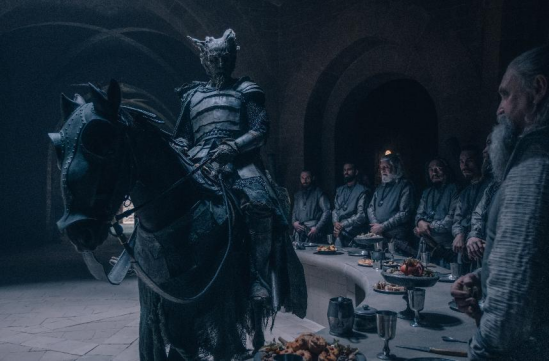
1. Plot: Inner Journey and Exploration of Human Nature
The Green Knight tells the story of young Sir Gawain (played by Dev Patel), who, in a mysterious challenge, pledges to face the test set by the Green Knight—to seek out the Knight and receive his blow a year from now. At the film’s outset, Gawain is an idle, youthful, impulsive knight, eager for glory and fame but lacking a true understanding of duty, courage, and mortality. The Green Knight’s challenge is not only an external adventure, but also a test of Gawain’s inner self.
Through a series of bizarre adventures and encounters with diverse characters, the film gradually reveals Gawain’s growth and transformation over the course of a year. Facing various temptations and adversities, he gradually understands the fragility of life, the true meaning of courage, and the inevitability of death. The film’s storyline not only depicts a man’s growth but also offers a profound reflection on the honor and duty inherent in medieval chivalry.
The film’s structure is nonlinear, full of metaphors and symbols, and many plots and images have a dreamlike quality, breaking the traditional narrative pattern of heroic adventure stories. Every encounter with the Green Knight actually means Gawain’s exploration of himself and the depths of human nature.
2. Character Development: The Profound Gawain and Other Mysterious Characters
- Sir Gawain (played by Dev Patel): Gawain is a complex and multi-layered character, blending youthful impulsiveness and a thirst for glory with a sense of uncertainty about the world and a fear of death. Dev Patel’s performance is exceptional, delicately portraying Gawain’s transformation from a cocky, frivolous young knight to a mature man confronting himself and his own mortality. Gawain is the film’s emotional core, and the audience witnesses his inner struggles and growth throughout his journey.
- The Green Knight (played by Randall Park): The Green Knight is a mysterious figure in the film, both an external threat and a symbol of fate, death, and the forces of nature. As Gawain’s challenger, the Green Knight’s appearance is not only a physical test but also a spiritual one. His image, imbued with mystery and symbolism, permeates the film, imbuing Gawain’s adventure with a profound philosophical dimension.
- Elsa (played by Alvin Ayre): Elsa is another crucial character in the film, a symbol of love and temptation. During Gawain’s journey, Elsa’s appearance presents him with a choice: to persevere in his mission or to indulge in immediate desires and pleasures? Elsa not only embodies Gawain’s inner struggle but also represents the uncertainty and fragility of human emotion.
- The Magician (played by Salma Hayek): A mysterious and profoundly wise character, the Magician provides guidance and inspiration for Gawain’s journey. Her presence not only advances the plot but also symbolizes the film’s philosophical themes, representing a dialogue with nature, fate, and the inner self.
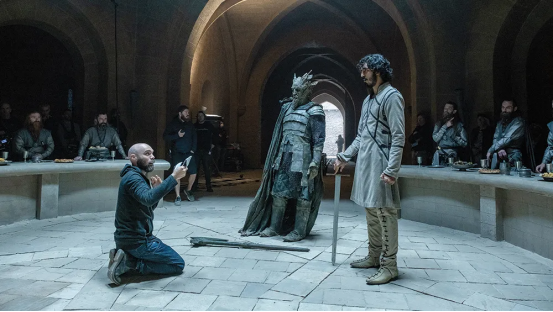
3. Visual Effects and Photography: Dreamlike Images and Poetic Expression
“The Green Knight” is a work of visual and poetic beauty, captured in a dreamlike style with exquisitely composed, detailed, and layered images. Each frame, like a ripped image from an ancient painting, is imbued with mystery and symbolism. Cinematographer Andrew Droz Palermo uses his unique lens to bring a world of fantasy to life.
The film’s abundant natural landscape shots and delicate color schemes not only enhance the fantastical atmosphere but also lend the film’s emotional depth. Whether it’s Gawain traversing the wilderness, battling monsters, or his final confrontation with the Green Knight, the aesthetics of the shots create a strong sense of immersion.
The film’s visuals eschew the dazzling special effects common in traditional fantasy films, opting instead for a hazy, poetic approach. This choice complements the film’s themes, enhancing its philosophical depth and making the story more contemplative.
4. Music and Atmosphere: The emotional depth and atmosphere of the music
The film’s music, composed by Daniel Hart, combines sound effects and musical styles to enhance the film’s emotional depth and atmosphere. The music’s melodies are simple yet profound, sometimes soaring and sometimes subdued, perfectly capturing Gawain’s inner world. The sound effects are closely integrated with the visuals, sometimes conveying a sense of uneasy foreboding and sometimes plunging the audience into contemplation, further enhancing the film’s captivating atmosphere.
The film’s soundtrack isn’t just background music; it’s closely tied to the characters’ emotional journeys. Each piece of music drives the characters’ emotions forward, allowing the audience to empathize with the music as it fluctuates.
5. Theme and Allegory: A profound reflection on life, death, and courage
More than just a fantasy adventure, “The Green Knight” explores profoundly universal themes of life, death, honor, courage, regret, and fate. Through the confrontation between Gawain and the Green Knight, the film offers audiences a complex exploration of courage and mortality. Gawain’s journey is not only about responding to external challenges but also about confronting his own fears, shame, and responsibility.
The film explores the contradictions of chivalry through its discussion of “honor” and “duty”: Should a true warrior be fearless, or should he make rational choices when facing death? The film also criticizes “glory” in modern society, showing how one can lose the most essential things in the pursuit of personal glory.
Ultimately, the film leaves no clear answer, leaving the audience to ponder. Gawain’s choice and the ending of the story are also full of openness, leaving room for people to explore the meaning of life and their own hearts.
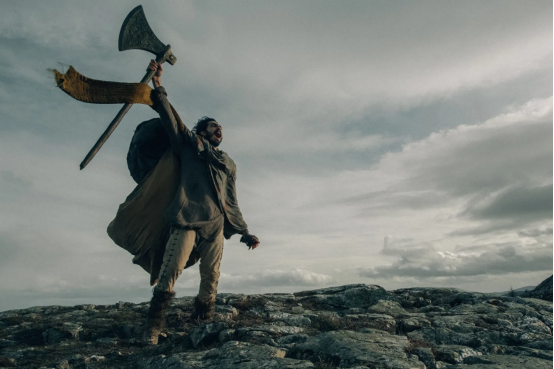
6. Overall evaluation: A profound philosophical allegory and a fantastical poetic work
“The Green Knight” is a fantasy film imbued with poetry and philosophical reflection, transcending traditional adventure genres to incorporate rich symbolism and inner exploration. With its complex narrative, profound themes, and exquisite visuals, the film offers audiences a profound reflection on life, death, and courage.
If you’re expecting a film full of fantasy adventures and spectacular battles, you might find “The Green Knight” more focused on philosophical and artistic expression. But if you’re interested in complex character development, inner growth, and poetic narratives, then this film is undoubtedly a visual and spiritual journey worthy of deep reflection.
Editorial boundary: This article is independent commentary and general cultural analysis. It is not official, authorized, endorsed, or affiliated with any studio, publisher, streaming platform, franchise, creator, or rights holder mentioned.