Studio Ghibli has long stood as a titan of global animation, not merely for its aesthetic brilliance but for its profound exploration of the human condition. From the visionary environmentalism of Hayao Miyazaki to the devastating realism of Isao Takahata, the studio’s filmography serves as a philosophical roadmap. This guide synthesizes the core narratives and underlying messages of several Ghibli masterpieces, offering a detailed analysis of how these stories reflect our world, our history, and our future.
The Wind Rises: Chasing Dreams Amidst the Gale of History
The Wind Rises represents Hayao Miyazaki’s most grounded and perhaps most personal work. It chronicles the life of Jiro Horikoshi, the designer of the Mitsubishi A6M Zero fighter, set against the backdrop of Japan’s turbulent Taisho and Showa eras. The film is a meditation on the “beautiful dream” of creation and the often-tragic reality of how those dreams are utilized by the world.
The Paradox of Creation and Destruction
Jiro’s obsession with aeronautical engineering is depicted as a pure, artistic pursuit. However, the film constantly reminds the audience that his “beautiful airplanes” are destined to become tools of destruction. This creates a central tension: can an artist or engineer be held responsible for the ultimate application of their work? The film suggests that while the wind of history blows fiercely and often cruelly, the individual must still strive to live and create.
The Fleeting Nature of Beauty and Love
The relationship between Jiro and Nahoko Satomi serves as the emotional heart of the film. Their love is shadowed by Nahoko’s tuberculosis, mirroring the fragility of Jiro’s aviation dreams. The phrase “The wind is rising! We must try to live,” taken from Paul Valéry’s poem, encapsulates the film’s ethos. It is a call to embrace the moments of beauty and connection even when the surrounding world is descending into chaos.

Nausicaä of the Valley of the Wind: An Ecological Prophecy
As one of the foundational works of the studio, Nausicaä of the Valley of the Wind established the environmental themes that would define Miyazaki’s career. Set in a post-apocalyptic world where humanity struggles to survive alongside the “Sea of Decay,” the film explores the destructive nature of human hubris and the possibility of coexistence with nature.
The Sea of Decay and the Ohmu
The Sea of Decay (Fukai) is initially presented as a threat—a toxic forest of giant fungi and lethal spores. However, Nausicaä discovers that the forest is actually purifying the earth, absorbing the toxins left behind by ancient industrial wars. The Ohmu, massive trilobite-like insects, act as the forest’s guardians. Their rage is a direct response to human aggression, illustrating a feedback loop where violence against nature results in nature’s violent retaliation.
Nausicaä as the Bridge Between Worlds
Nausicaä herself is a rare protagonist who seeks to understand rather than conquer. Her ability to communicate with the Ohmu and her scientific curiosity about the Fukai represent a path forward for humanity. She rejects the scorched-earth tactics of the Tolmekian Empire, demonstrating that true survival lies in humility and the recognition that humans are but one part of a vast, interconnected ecosystem.

Grave of the Fireflies: The Devastating Reality of War
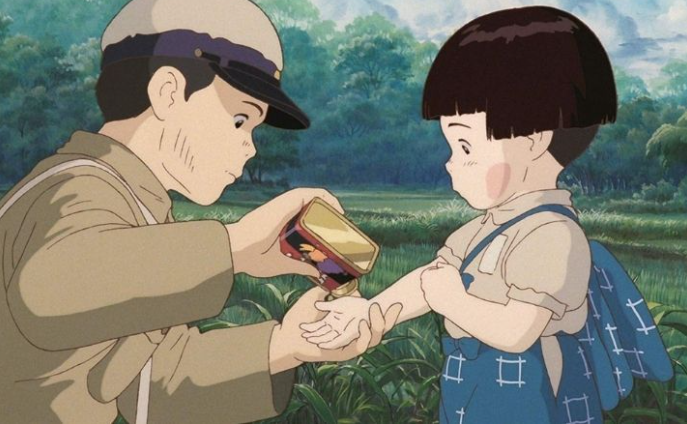
While Miyazaki often uses fantasy to explore serious themes, Isao Takahata’s Grave of the Fireflies is a stark, uncompromising look at the consequences of war. It follows two siblings, Seita and Setsuko, as they attempt to survive in the final months of World War II after their mother is killed in a firebombing raid.
The Breakdown of Social and Sibling Bonds
The film is a harrowing examination of how war erodes social empathy. As resources become scarce, the siblings find themselves ostracized by their own relatives and community. Seita’s desperate attempts to care for his younger sister are both heroic and tragic, as his pride and the harsh reality of their circumstances lead to a slow, agonizing decline. The fireflies serve as a poignant metaphor for the brevity and fragility of life, their short-lived glow reflecting the doomed innocence of the children.
A Critique of Patriotism and Pride
Unlike many war films, Grave of the Fireflies does not focus on soldiers or grand political maneuvers. Instead, it focuses on the collateral damage—the children left behind. It critiques the blind nationalism that leads to such suffering and the individual pride that can prevent one from seeking help when it is most needed. It remains one of the most powerful anti-war statements in cinematic history.

Castle in the Sky: Technology, Greed, and the Return to Earth
Castle in the Sky (Laputa) is a classic adventure that delves into the dangers of lost technology and the corrupting influence of power. The floating city of Laputa represents the pinnacle of human achievement, but its fall serves as a warning about the sustainability of a civilization detached from the earth.
The Conflict Between Purity and Ambition
The protagonists, Pazu and Sheeta, represent a pure-hearted desire for discovery and connection. In contrast, the antagonist Muska seeks to weaponize Laputa’s ancient technology to establish a global dictatorship. The film highlights the ethical responsibility that comes with scientific advancement. The “Volucite” crystal, which powers the city, can be used for wonder or for mass destruction, depending on the heart of the wielder.
The Necessity of Groundedness
The climax of the film reinforces the idea that humanity cannot survive in isolation from the natural world. Sheeta’s recitation of the Gondoa poem—”Root yourself in the earth, live together with the wind”—is the ultimate resolution. Even the most advanced technology cannot sustain a people who have forgotten their connection to the soil. The abandonment of Laputa at the end is not a loss, but a liberation.

Porco Rosso: Solitude, Honor, and the Rejection of Humanity
Set in the Adriatic Sea during the interwar period, Porco Rosso tells the story of Marco Pagot, an Italian WWI ace pilot who has been cursed (or has cursed himself) to look like a pig. The film is a sophisticated blend of adventure, romance, and political commentary.
The Pig as a Symbol of Anti-Fascism
Marco’s transformation is a physical manifestation of his disillusionment with humanity. Living in the shadow of rising fascism in Italy, he famously remarks, “I’d rather be a pig than a fascist.” By rejecting his human form, he rejects the violence and corruption of the era. His life as a bounty hunter on a secluded island is a form of self-imposed exile, reflecting a deep-seated desire for personal freedom and moral integrity.
The Spirit of Aviation
The film is also a love letter to early aviation. The dogfights and the technical details of the seaplanes are rendered with immense care. Aviation in Porco Rosso represents a realm of honor and skill that transcends national boundaries. Even the rivalry between Porco and the American pilot Curtis is governed by a sense of chivalry that is rapidly disappearing from the world on the ground.

Howl’s Moving Castle: The Architecture of the Heart
Howl’s Moving Castle is a visual masterpiece that explores the fluid nature of identity and the redemptive power of love. Through the journey of Sophie, a young woman cursed with an old body, the film examines how our internal states shape our external reality.
Magic as a Facade for Insecurity
The wizard Howl is initially presented as a vain, powerful figure living in a chaotic, shifting castle. However, his magic is revealed to be a defense mechanism against his own fears and the encroaching war. His “moving castle” is a metaphor for his fragmented and unsettled heart. Sophie’s presence brings stability to this chaos, showing that true strength comes not from magical prowess, but from emotional maturity and selflessness.
The Transformation of Sophie
Sophie’s curse is unique in that its effects fluctuate based on her confidence and state of mind. When she is brave and assertive, she appears younger; when she is resigned, she appears older. This emphasizes the film’s message that we are not defined by our age or appearance, but by the “heart” we maintain. In a world torn apart by magical and industrial warfare, the simple act of caring for others becomes the most potent form of magic.

Comparative Analysis of Recurring Ghibli Themes
While each film is distinct, they share a cohesive thematic DNA. The following table highlights how core concepts are addressed across these different narratives:
| Theme | The Wind Rises | Nausicaä | Castle in the Sky | Howl’s Moving Castle |
|---|---|---|---|---|
| Nature | The wind as a force of destiny. | The earth purifying itself from toxins. | The necessity of returning to the soil. | Nature as a backdrop to magical conflict. |
| Technology | Aviation as a beautiful but deadly dream. | Ancient weapons (God Warriors) as a threat. | Lost technology used for conquest. | Industrialized war machines vs. magic. |
| Growth | Professional and personal maturity. | Spiritual awakening and sacrifice. | Coming-of-age and bravery. | Self-acceptance and emotional healing. |

The Global Impact and Artistic Legacy of Studio Ghibli
Studio Ghibli’s influence extends far beyond the borders of Japan. By refusing to simplify complex moral issues, the studio has created a body of work that resonates with audiences of all ages. Their films do not rely on traditional “good vs. evil” tropes; instead, they present characters with conflicting motivations and worlds where the solution is often found in empathy and balance.
Hand-Drawn Excellence in a Digital Age
One of the hallmarks of Ghibli is its commitment to traditional hand-drawn animation. This dedication provides a tactile, “lived-in” feel to their worlds, from the lush forests of the Valley of the Wind to the cluttered, magical interior of Howl’s castle. This aesthetic choice reinforces the studio’s emphasis on human craftsmanship and the beauty of the natural world.
A Legacy of Empathy
Ultimately, the legacy of Studio Ghibli is one of empathy. Whether it is feeling the grief of Seita and Setsuko or the soaring ambition of Jiro, the films demand that the viewer engage deeply with the emotional lives of others. This focus on the “heart” ensures that Ghibli’s stories will remain relevant for generations to come.
Frequently Asked Questions (FAQ)
- Q1: Is ‘The Wind Rises’ a true story?
- It is a fictionalized biography. While Jiro Horikoshi was a real person, the film blends his life with elements from Tatsuo Hori’s novel ‘The Wind Has Risen,’ particularly the romantic subplot involving Nahoko.
- Q2: Why does Porco Rosso look like a pig?
- The film suggests the curse is self-inflicted. Marco’s disillusionment with humanity and his guilt over surviving his comrades in WWI caused him to “leave” humanity behind, manifesting as his porcine appearance.
- Q3: What is the significance of the fireflies in ‘Grave of the Fireflies’?
- Fireflies represent the ephemeral nature of life and the souls of the departed. Their short lifespan mirrors the tragic fate of the children, and their light provides a fleeting moment of beauty in a dark world.
- Q4: Is Nausicaä of the Valley of the Wind officially a Studio Ghibli film?
- While it was produced by Topcraft and released before Studio Ghibli was officially founded, it is considered the “founding” film of the studio and is included in all Ghibli collections due to the involvement of Miyazaki and Suzuki.
- Q5: What is the main message of Howl’s Moving Castle?
- The film focuses on the idea that true beauty and strength come from within. It emphasizes that love and self-acceptance can break any curse, and that war is a futile endeavor that only leads to the loss of one’s humanity.
Editorial boundary: This article is independent commentary and general cultural analysis. It is not official, authorized, endorsed, or affiliated with any studio, publisher, streaming platform, franchise, creator, or rights holder mentioned.