The Architecture of a Manufactured Reality
Peter Weir’s 1998 film, The Truman Show, serves as a prescient critique of voyeurism and media manipulation. At its core, the film presents Seahaven as a controlled environment—a microcosm of a society obsessed with the performative nature of life. Truman Burbank’s existence is not merely a television show; it is a meticulously curated simulation where every sunrise, rain shower, and interpersonal interaction is a product of directorial design.
The Philosophy of the Panopticon
The concept of the Panopticon, originally proposed by Jeremy Bentham, is central to understanding Truman’s plight. In this structure, the subject is constantly watched but never knows when the gaze is active. Unlike the traditional prison, Truman is a willing participant who has internalized the surveillance, making the psychological cage far more effective than physical bars.

The Psychological Impact of Perpetual Surveillance
Living under the gaze of millions creates a profound sense of “existential displacement.” Truman’s journey is one of gradual awakening as he notices the glitches in his reality—the falling studio light, the rotating radio signals, and the repetitive behavior of the townspeople. These moments of cognitive dissonance force him to question the veracity of his world.
Common Signs of Reality Disconnection
- Repetitive Patterns: The realization that people follow rigid scripts and daily loops.
- Technological Glitches: Erratic behavior from environmental control systems.
- The Outsider’s Truth: Encounters with characters like Sylvia who attempt to break the fourth wall.

The Ethics of Modern Media and Voyeurism
The film anticipates the rise of reality television and social media culture. The audience in the film represents the viewer at home: complicit, desensitized, and hungry for the “authentic” suffering of others. This raises a critical ethical question: do we have the right to consume another person’s life as content?
| Aspect | The Truman Show Reality | Modern Digital Reality |
|---|---|---|
| Control | Centralized (Christof) | Decentralized (Algorithms) |
| Privacy | Zero | Voluntarily Sacrificed |
| Motivation | Entertainment | Engagement/Validation |

Breaking Free: The Quest for Authenticity
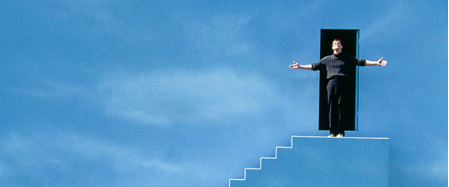
Truman’s final bow at the exit door is the ultimate act of defiance. It is a rejection of the comfort of the lie in favor of the terrifying uncertainty of the real world. This transition represents the “Hero’s Journey” in a postmodern context—where the dragon to be slain is the illusion of one’s own comfort zone.
Pro Tips for Identifying Your Own “Seahaven”
To lead an authentic life, one must regularly audit their environment. Are your opinions truly yours, or are they curated by the algorithms you consume? Seek out “glitches”—experiences that challenge your worldview and force you to step outside your comfort zone.
Frequently Asked Questions (FAQ)
- Is The Truman Show considered a dystopian film?
- Yes, it is often categorized as a “soft dystopia.” Unlike the overt oppression of 1984, the control in The Truman Show is sugar-coated with comfort, making it a much harder cage to escape.
- What does the character of Christof represent?
- Christof serves as a god-like figure, representing the creator, the director, and the invasive power of media conglomerates that monetize human experience.
- Why does Truman eventually leave the show?
- His desire for truth and his love for Sylvia outweigh his fear of the unknown. It is a triumph of human agency over systemic programming.
- How does this film relate to modern social media?
- The film mirrors the “curated self” seen on platforms like Instagram and TikTok, where individuals perform their lives for an invisible, constant audience.
Editorial boundary: This article is independent commentary and general cultural analysis. It is not official, authorized, endorsed, or affiliated with any studio, publisher, streaming platform, franchise, creator, or rights holder mentioned.